The room
The Alhambra towers in Madrid
What the real Torres Bermejas are in Granada, how Nasrid decoration works, and what the Madrid tablao borrows from them for its tiles, timber and arches.
Reserve your flamenco evening ↗Two places with one name
Torres Bermejas means two things. In Granada it is a set of three towers on the Mauror hill, facing the Alhambra and the Generalife across the valley. In Madrid it is a flamenco tablao whose interior is made to recall those towers. The two stand in different cities and share the name and the decor, and little else. When you sit in the Madrid room you are in a recreation, built to suggest the Alhambra, not in the fortress itself.
What the real towers are
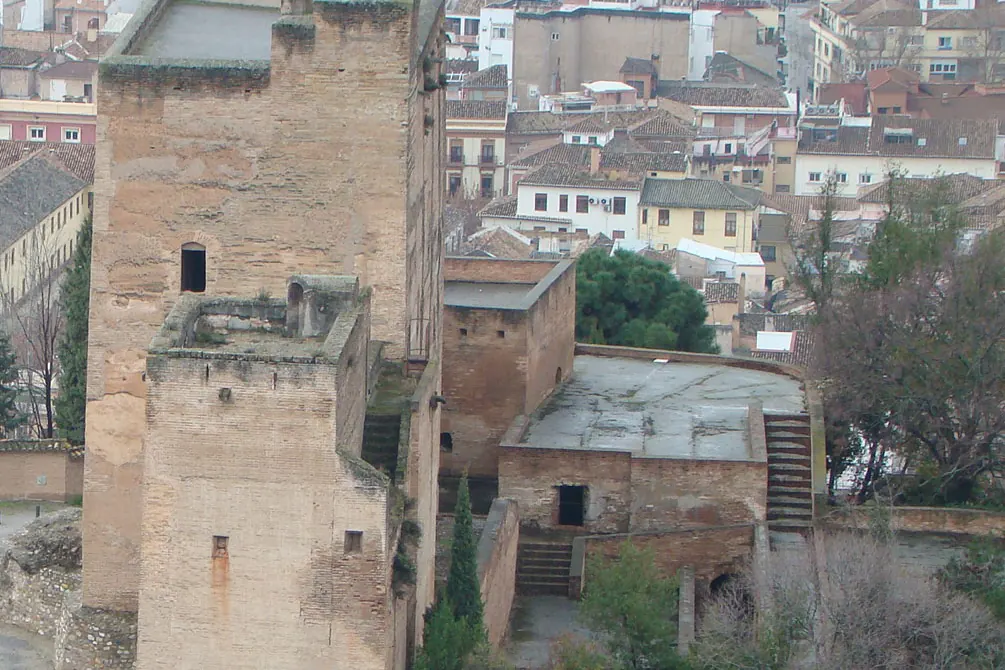
The Granada towers were built of rammed earth, a method that compacts earth in layers to form solid walls. The oldest remains date from the late 8th and early 9th centuries, and the Nasrid dynasty modified the complex in the 13th century. They were renovated in the 16th century and restored again between 1854 and 1858. For long stretches they served as barracks and as a military prison, and the Patronato de la Alhambra y Generalife acquired them in 1962, a very different life from the entertainment the Madrid tablao offers.
Why the Alhambra looks red
The name Alhambra comes from the Arabic al-Ḥamrāʼ, meaning the red one, from the longer phrase for the red fortress. Its walls are rammed earth, and the reddish colour comes from iron oxide in the local clay. In English the Torres Bermejas are often called the Vermilion Towers, and their Spanish name points to the same reddish colour. When the tablao evokes those towers, it evokes a colour as much as a shape, and the warm palette of the room follows that idea.
The decoration the room borrows
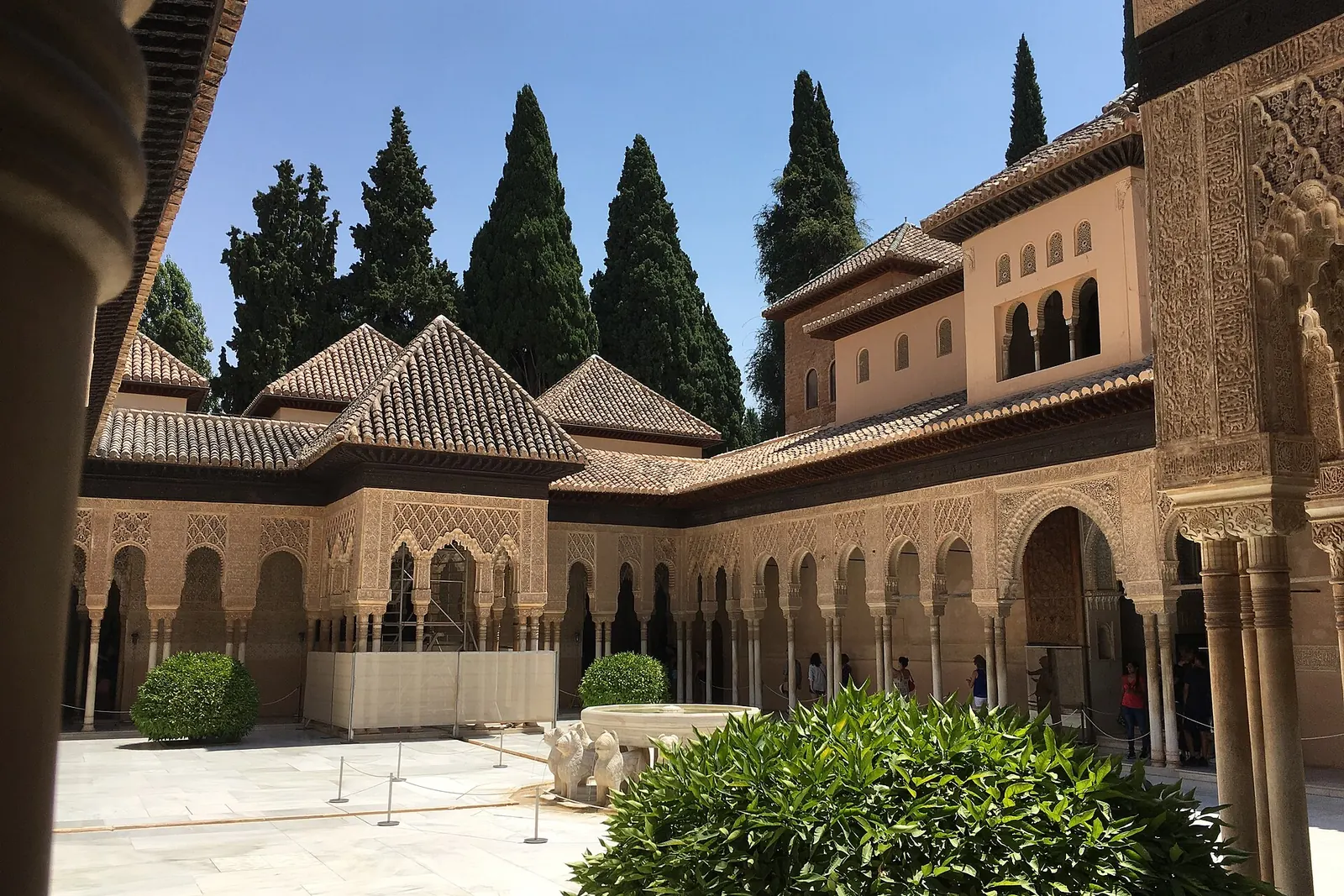
Nasrid interiors use a small set of techniques. Muqarnas are stalactite-like stucco forms that make vaults look honeycombed. Tile mosaics, called alicatado in Spanish, cover lower walls and floors. Ceilings are often pine, carved, painted and set with geometric patterns, and upper walls carry stucco with plant arabesques, Arabic inscriptions and geometric designs. The tablao's own description names Arab-style motifs, tiles and coffered wooden ceilings, so the room borrows the same vocabulary of pattern, tile and carved wood on a much smaller scale.
A recreation, not a copy
The operator says the room reproduces the interior of the Torres Bermejas of the Alhambra, and Madrid's tourism site calls it a detailed recreation. Take that as an interpretation: a stage set in the Moorish manner, made for audiences in the 20th century. The Nasrid palaces themselves are far larger and more intricate than any restaurant room. The pleasure of the tablao is the atmosphere, with pattern and shadow around a stage, not an exact architectural study, and it works best when you let the room set the mood.
Why a Moorish room for flamenco?
Flamenco grew in Andalusia, and Granada, capital of the Nasrid emirate, belongs to that region's story. The Nasrids were the last Muslim dynasty in the Iberian Peninsula and the longest-reigning, and Muhammad I began building the Alhambra in 1238. UNESCO describes Andalusia as the heartland of flamenco, with roots reaching into Murcia and Extremadura. A Moorish-style room ties a Madrid stage to the culture of the south, though the performers bring their own training and repertoire to it.
If you want the real towers
To see the real Torres Bermejas you need to go to Granada. The towers stand on a hill facing the Alhambra, and heritage information lists them among the monuments of the city. Opening conditions change, so check the Alhambra's visitor pages before planning a trip around them. A Madrid evening at the tablao is a way to enjoy the style, not a substitute for a visit to the place itself, and the two make a sensible pair if your route ever takes you to Andalusia.
Sources